
Meet the living subject or observe the natural phenomenon first. Ask a few questions aloud and give students time to discover what observation can answer. Leave the unanswered questions for later research. A sketch or written narration belongs in a paper nature journal.
This historical lesson is reproduced as a source, not as current animal-care, collecting, medical, or experiment advice. Observe wildlife without disturbing it, follow local rules, and check present-day safety guidance before any hands-on work. Never look directly at the Sun.
01How to use this lessonA short field guide for the adult
Let the subject lead.
Read the teacher material in advance if possible. During observation, select only the questions the student can investigate today. Do not answer on the student’s behalf while there is still something to see, hear, compare, or measure safely. Afterward, invite an oral narration or a picture in a paper nature journal. Discuss remaining questions only once observation is complete.
02The teacher’s readingComstock’s original preparatory text
The teacher’s reading
Text from the original handbook. Page markers are omitted; layout is adapted for reading. The source may reflect 1911 knowledge and practices.
Teacher’s Story
There are many beautiful carpets spread before the feet of advancing spring, but perhaps none of them are so delicate in pattern as those woven by these two plants that spread their fernlike leaves in April and May. There is little difference in the foliage of the two; both are delicate green and lacelike above, and pale, bluish green on the underside. And each leaf, although so finely divided, is, after all, quite simple; for it has three chief divisions, and these in turn are divided into three, and all the leaves come directly from the root and not from stems. These plants love the woodlands, and by spreading their green leaves early, before the trees are in foliage, they have the advantage of the spring sunshine. Thus they make their food for maturing their seeds, and also store some of it in their roots for use early the following spring. By midsummer the leaves have entirely disappeared, and another carpet is spread in the place which they once covered.
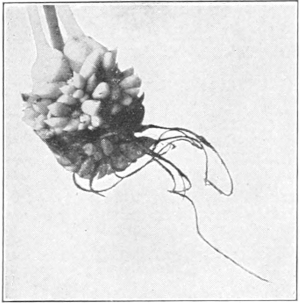
The underground store-house of Dutchman’s breeches.
Dutchman’s breeches and squirrel corn resemble each other so closely that they are often confused; however, they are quite different in form; the “legs” of the Dutchman’s breeches are quite long and spread wide apart, while the blossoms of the squirrel corn are rounded bags instead of “legs.” The roots of the two are quite different. The Dutchman’s breeches grows from a little bulb made up of grayish scales, while the squirrel corn develops from a round, yellow tuber; these yellow, kernel-like tubers are scattered along the roots, each capable of developing a plant next year. The Dutchman’s breeches likes thin woodlands and rocky hillsides, but the squirrel corn prefers rich, moist woods. The blossom of the Dutchman’s breeches comes the earlier of the two. These flowers are white with yellow tips, and are not fragrant. The flowers of the squirrel corn are grayish with a tinge of magenta, and are fragrant.
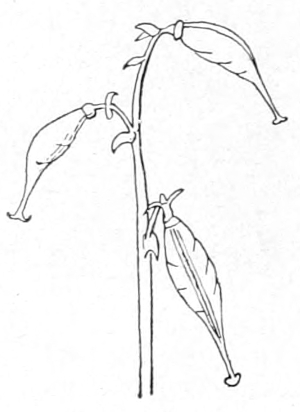
Seed capsule of squirrel corn.
The legs of the Dutchman’s breeches are nectar pockets with tubes leading to them, and are formed by two petals. Opposite these two petals are two others more or less spoon-shaped, with the spoon bowls united to protect the anthers and stigma. There are two little sepals which are scalelike.
The seed capsule of the Dutchman’s breeches is a long pod with a slender, pointed end, and it opens lengthwise. The seed capsules of the squirrel corn are similar and I have found in one capsule, 12 seeds, which were shaped like little kernels of corn, black in color and polished like patent leather.
03The original lesson and questionsTake these to the subject itself
Questions to explore
Choose what fits this encounter. Some original prompts ask for collecting, handling, or other historical activities; use a safe observation instead. Write or draw only in a paper nature journal.
Dutchman’s Breeches and Squirrel Corn
Leading thought—The Dutchman’s breeches, or “boys and girls,” as it is often called, is one of the earliest flowers of rich woodlands. There are interesting differences between this flower and its close relative, squirrel corn. The flowers of both of these resemble in structure the flowers of the bleeding heart.
Method—As the Dutchman’s breeches blossoms in April and May and the squirrel corn in May and June, we naturally study the former first and compare the latter with it in form and in habits. The questions should be given the pupils, for them to answer for themselves during their spring walks in the woodlands.
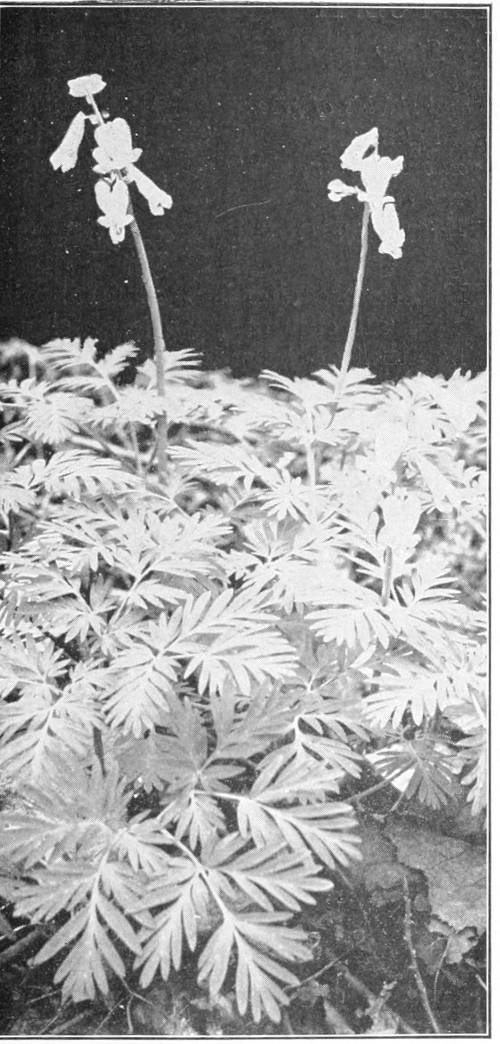
Squirrel corn.
Observations—1. Where do you find Dutchman’s breeches? Which do you prefer to call these flowers, Dutchman’s breeches or boys and girls? Are there leaves on the trees when these flowers are in bloom?
2. Which blossoms earlier in the season, Dutchman’s breeches or squirrel corn? How do the flowers of the two differ in shape? In odor?
3. In the flower of the Dutchman’s breeches find two petals which protect the nectar. How do they look? What part do they form of the breeches? Find two other petals which protect the pollen and stigma.
4. Find the two sepals. How many bracts do you find on the flower stem?
5. What insects visit these flowers? Describe how they get the nectar.
6. What sort of root has the Dutchman’s breeches? What is the difference between its root and that of the squirrel corn? Have you ever seen squirrels harvesting squirrel corn? What is the purpose of the kernels of the squirrel corn?
7. Study the leaf. How many main parts are there to it? How are these parts divided? Does the leaf come straight from the root or from a stem? What is the color of the leaf above? Below? Can you distinguish the leaves of the Dutchman’s breeches from those of the squirrel corn?
8. Describe the seed capsule of Dutchman’s breeches. How does it open? How many seeds has it? Compare this with the fruit of squirrel corn and describe the difference.
9. What happens to the leaves of these two plants late in summer? How do the plants manage to get enough sunlight to make food to mature their seed? What preparations have they made for early blossoming the next spring?
Comstock, Handbook of Nature-Study, Lesson CXXI. Read the illustrated original at Project Gutenberg. Public domain in the United States.