
Meet the living subject or observe the natural phenomenon first. Ask a few questions aloud and give students time to discover what observation can answer. Leave the unanswered questions for later research. A sketch or written narration belongs in a paper nature journal.
This historical lesson is reproduced as a source, not as current animal-care, collecting, medical, or experiment advice. Observe wildlife without disturbing it, follow local rules, and check present-day safety guidance before any hands-on work. Never look directly at the Sun.
01How to use this lessonA short field guide for the adult
Let the subject lead.
Read the teacher material in advance if possible. During observation, select only the questions the student can investigate today. Do not answer on the student’s behalf while there is still something to see, hear, compare, or measure safely. Afterward, invite an oral narration or a picture in a paper nature journal. Discuss remaining questions only once observation is complete.
02The teacher’s readingComstock’s original preparatory text
The teacher’s reading
Text from the original handbook. Page markers are omitted; layout is adapted for reading. The source may reflect 1911 knowledge and practices.
Teacher’s Story
It would be well for the designer of tapestries to study the carpets of our forests for his patterns, for he would find there a new carpet every month, quite different in plan and design from the one spread there earlier or later. One of the most beautiful designs from Nature’s looms is a trillium carpet, which is at its best when the white trilliums are in blossom. It is a fine study of the artistic possibilities of the triangle when reduced to terms of leaves, petals and sepals.
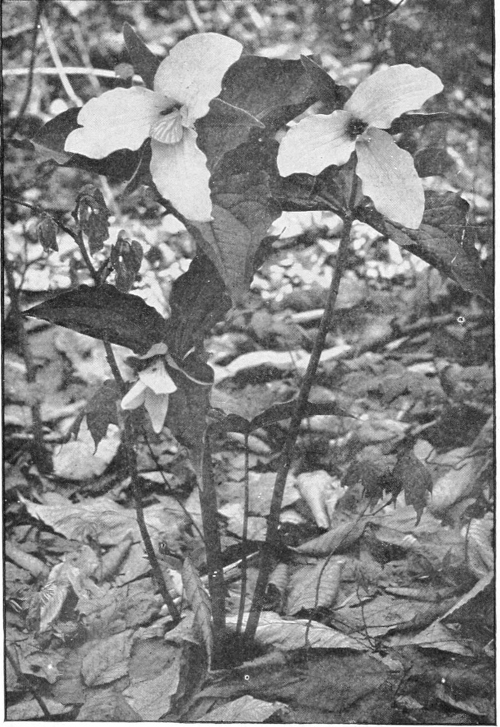
The white trillium. A white butterfly visiting the flower at the left.
Photo by Verne Morton.
The trillium season is a long one; it begins in April with the purple wake-robin or birthroot, the species with purple, red, or sometimes yellowish flowers. The season ends in June with the last of the great white trilliums, which flush pink instead of fading, when old age comes upon them.
The color of the trillium flower depends upon the species studied; there are three petals, and the white and painted trilliums have the edges of the petals ruffled; the red and nodding trilliums have petals and sepals nearly the same size, but in the white trillium the sepals are narrower and shorter than the petals. The sepals are alternate the petals, so that when we look straight into the flower we see it as a six-pointed star, three of the points being green sepals. The pistil of the trillium is six-lobed. It is dark red in the purple trillium and very large; in the white species, it is pale green and smaller; it opens at the top with three flaring stigmas. There are six stamens with long anthers, and they stand between the lobes of the pistil. The flower stalk rises from the center where three large leaves join. The flower stalk has a tendency to bend a little, and is rather delicate. The three leaves have an interesting venation, and make a good subject for careful drawing. The flower stem varies with different species, and so does the length of the stem of the plant, the latter being fleshy and green toward the top and reddish toward the root. The trilliums have a thick, fleshy, and much scarred rootstock from which extend rootlets which are often corrugated. The trilliums are perennial, and grow mostly in damp, rich woods. The painted trillium is found in cold, damp woods along the banks of brooks; the white trillium is likely to be found in large numbers in the same locality, while the purple trillium is found only here and there. Flies and beetles carry the pollen for the red trillium, being attracted to it by its rank odor, which is very disagreeable to us but very agreeable to them. The large white trillium is visited by bees and butterflies. The fruit of the trillium is a berry, that of the purple species is somewhat six-lobed and reddish. In late July the fruit of the white trillium is a cone with six sharp wings, or ridges, from apex to base, the latter being three-quarters of an inch across. These vertical ridges are not evenly spaced, and beneath them are packed as closely as possible the yellow-green seeds, which are as large as homeopathic pills. In cross section, it can be seen that the trillium berry is star-shaped with three compartments, the seeds growing on the partitions. This trillium fruit is very rough outside, but smooth inside, and the dried stamens often still cling to it.
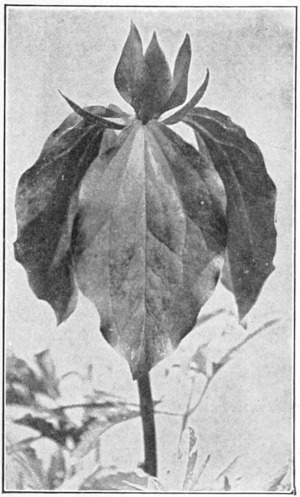
The stemless trillium
The trilliums are so called from the word triplum, meaning three, as there are three leaves, three petals, and three sepals.
03The original lesson and questionsTake these to the subject itself
Questions to explore
Choose what fits this encounter. Some original prompts ask for collecting, handling, or other historical activities; use a safe observation instead. Write or draw only in a paper nature journal.
The Trillium
Leading thought—The trilliums are lilies, and are often called wood lilies, because of their favorite haunts. There are several species, but they are all alike in that they have three sepals, three petals and three leaves.
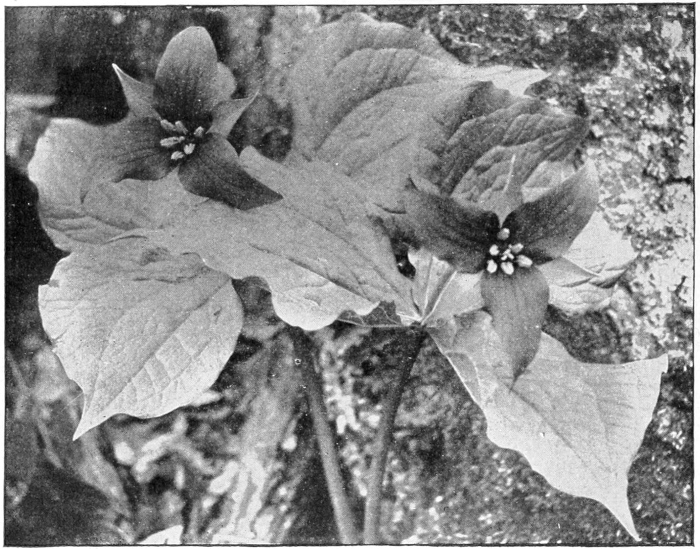
The purple trillium.
Photo by Verne Morton.
Method—This lesson may be given from trilliums brought to the schoolroom by the pupils, who should be encouraged to watch the development of the berry and also to learn all the different species common to a locality.
Observations—1. How many leaves has the trillium? How are they arranged? Draw a leaf showing its shape and veins. Describe the stem of the plant below the leaves, giving the length and color.
2. How far above the leaves does the flower stem or pedicel extend? Does the flower stand upright or droop? Describe or sketch the colors, shape and arrangement of the petals and sepals. Do the petals have ruffled margins?
3. Describe the pistil and the stigmas. Describe the stamens and how they are placed in relation to the pistil.
4. Do the flowers remain open during cloudy days and nights?
5. What insects do you find visiting the trilliums? Do the same insects visit the purple and the white trilliums? What is the difference in odor between the purple and the white trillium? Would this bring different kinds of insects to each?
6. How does the color of the white trillium change as the blossom matures? What is the color and shape of the fruit of each different species of trillium? When is the fruit ripe?
7. What kind of a root have the wake-robins? Do they grow from seed each year, or are they perennial? Where do you find them growing?
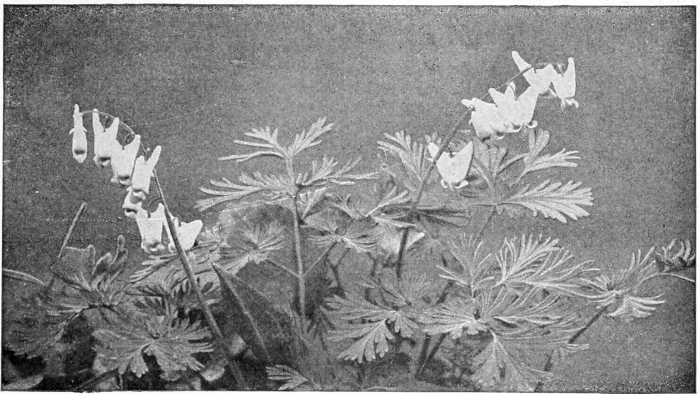
Dutchman’s breeches, or “boys and girls.”
Photo by O. L. Foster.
Comstock, Handbook of Nature-Study, Lesson CXX. Read the illustrated original at Project Gutenberg. Public domain in the United States.