
Meet the living subject or observe the natural phenomenon first. Ask a few questions aloud and give students time to discover what observation can answer. Leave the unanswered questions for later research. A sketch or written narration belongs in a paper nature journal.
This historical lesson is reproduced as a source, not as current animal-care, collecting, medical, or experiment advice. Observe wildlife without disturbing it, follow local rules, and check present-day safety guidance before any hands-on work. Never look directly at the Sun.
01How to use this lessonA short field guide for the adult
Let the subject lead.
Read the teacher material in advance if possible. During observation, select only the questions the student can investigate today. Do not answer on the student’s behalf while there is still something to see, hear, compare, or measure safely. Afterward, invite an oral narration or a picture in a paper nature journal. Discuss remaining questions only once observation is complete.
02The teacher’s readingComstock’s original preparatory text
The teacher’s reading
Text from the original handbook. Page markers are omitted; layout is adapted for reading. The source may reflect 1911 knowledge and practices.
Teacher’s Story
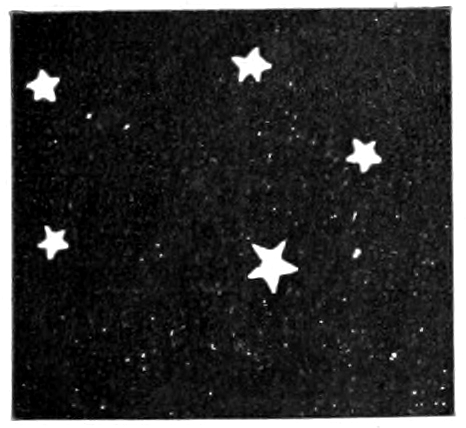
Capella in the constellation Auriga.
Capella is nearer to the North Star than any other of the bright stars and it comes very near belonging to the strictly polar constellations, since it falls below the horizon only four hours out of twenty-four. In composition it much resembles our sun, as do all the bright yellow stars; but it is much larger; it gives off one hundred and twenty times as much light as our sun, and it is forty light-years away from us. Capella is always a beautiful feature of the northern skies, being almost in the zenith during the evenings of January and February. It is in a brilliant shield-shaped constellation known as Auriga.
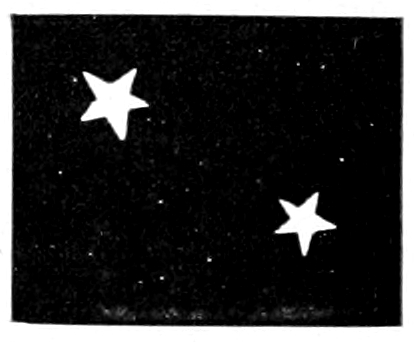
Gemini, the heavenly twins, the larger one is Pollux and the other is Castor.
During the winter evenings we see two stars set like glowing eyes almost in the zenith, and in a region of the sky where there are no other bright stars. These twin stars are set just a little closer together than are the pointers of the Big Dipper. To this brilliant pair the ancients gave the names of Castor and Pollux. Pollux is the brighter of the two and is the more southward in situation. Pollux and Castor were two beautiful twin boys who loved each other so much that, after they were dead, they were placed in the skies where they could always be near each other. The twin stars are supposed to exert a benign influence on oceans and seas and are, therefore, beloved by sailors. Although they seem to us so near together, they are separated by a space so great that we cannot conceive of it and they are going in opposite directions.
Pollux is a yellow star, and supposed to be in the same stage of development as our sun, while Castor is white and according to star ages is young. When a boy says “By Jimminy,” he does not realize that he is using an ancient expletive “By Gemini,” which is the Latin name of these twin stars and was a favorite ancient oath, especially of sailors.
03The original lesson and questionsTake these to the subject itself
Questions to explore
Choose what fits this encounter. Some original prompts ask for collecting, handling, or other historical activities; use a safe observation instead. Write or draw only in a paper nature journal.
Capella and the Heavenly Twins
Leading thought—There are, during the evenings of January and February, three brilliant stars almost directly overhead. One of these is Capella, the other two are the Heavenly Twins.
Method—Place on the board the part of the chart (p. 895) showing the Big Dipper, Pole-star, Capella and the Twins. Draw a line, L, from the pointers of the Big Dipper, and extend it to the Pole-star. Draw another line, K, from the Pole-star at right angles to the line L, and on the side away from the Big Dipper’s handle, and it will pass through a large, brilliant, yellow star which is Capella. Ask the pupils to imagine similar lines drawn across the sky, when they are making their observations and thus find these stars, and to place them on their charts, making the following observations:
1. What color is Capella, and how does its color compare with that of our sun?
2. Is Capella as near to the Pole-star as the Big Dipper? Is it near enough so that it never sets?
3. Can you see the shield-like constellation of which Capella is a part? Do you know the name of this constellation?
4. How do you find the Heavenly Twins after you have found Capella?
5. Why are these stars called the Heavenly Twins? What is their Latin name? What are the names of the two stars? Are these twins set nearer together than the pointers of the Big Dipper?
6. How can you tell the Heavenly Twins from the Little Dog Star and its companion?
7. Read in the books all that you can find about the Heavenly Twins. Try and find if they are the same age, if they are as near together as they seem, and if they are going in the same direction. What did the ancient sailors think of these twin stars?
Comstock, Handbook of Nature-Study, Lesson CCXXX. Read the illustrated original at Project Gutenberg. Public domain in the United States.