
Meet the living subject or observe the natural phenomenon first. Ask a few questions aloud and give students time to discover what observation can answer. Leave the unanswered questions for later research. A sketch or written narration belongs in a paper nature journal.
This historical lesson is reproduced as a source, not as current animal-care, collecting, medical, or experiment advice. Observe wildlife without disturbing it, follow local rules, and check present-day safety guidance before any hands-on work. Never look directly at the Sun.
01How to use this lessonA short field guide for the adult
Let the subject lead.
Read the teacher material in advance if possible. During observation, select only the questions the student can investigate today. Do not answer on the student’s behalf while there is still something to see, hear, compare, or measure safely. Afterward, invite an oral narration or a picture in a paper nature journal. Discuss remaining questions only once observation is complete.
02The teacher’s readingComstock’s original preparatory text
The teacher’s reading
Text from the original handbook. Page markers are omitted; layout is adapted for reading. The source may reflect 1911 knowledge and practices.
Teacher’s Story
ALTHOUGH the American elm loves moist woods, it is one of those trees that enjoys gadding; and without knowing just how it has managed to do it, we can see plainly that it has planted its seeds along fence corners, and many elms now grace our fields on sites of fences long ago laid low. Because of its beautiful form and its rapid growth, the elm has been from earliest times a favorite shade tree in the Eastern and Middle States. Thirty years after being planted, the elms on the Cornell Campus clasped branches across the avenues; and the beauty of many a village and city is due chiefly to these graceful trees of bounteous shade. Moreover the elm is at no time more beautiful than when it traces its flowing lines against the background of snow and gray horizon. Whether the tree be shaped like a vase or a fountain, the trunk divides into great uplifting branches, which in turn divide into spray that oftentimes droops gracefully, as if it were made purposely to sustain from its fine tips the woven pocket-nest of the oriole. No wonder this bird so often chooses the elm for its roof-tree!
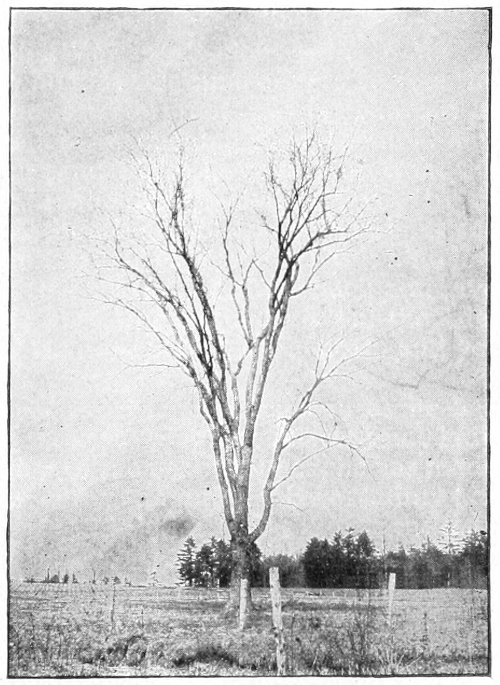
The elm in winter.
In winter, the dark, coarsely-ridged bark and the peculiar, wiry, thick spray, as well as the characteristic shape of the tree reveal to us its identity; it also has a peculiar habit of growing its short branches all the way down its trunk, making it look as if it were entwined with a vine. The elm leaf, although its ribs are straight and simple, shows a little quirk of its own in the uneven sides of its base where it joins the petiole; it is dark green and rough above, light green and somewhat rough below; but this leaf is rough only when stroked in certain directions, while the leaf of the slippery elm is rough whichever way it may be stroked. The leaf has the edges saw-toothed, which are in turn toothed; the petiole is short. The leaf comes out of the bud in the spring folded like a little fan; but before the fans are opened to the spring breezes, the elm twigs are furry with reddish green blossoms. The blossom consists of a calyx with an irregular number of lobes, and for every lobe, a stamen which consists of a threadlike filament from which hangs a bright red anther; at the center is a two-celled pistil with two light green styles. These blossoms appear in March or early April, before the leaves.
When full-grown the fruit hangs like beaded fringe from the twigs. The seed is flat and has a wide, much veined margin or wing, notched at the tip and edged with a white silken fringe; the seed is at the center, wrinkled and flat. Each seed shows at its base the old calyx and is attached by a slender threadlike stem to the twig at the axils of last year’s leaves. A little later the lusty breezes of spring break the frail threads and release the seeds, although few of them find places fit for growth.
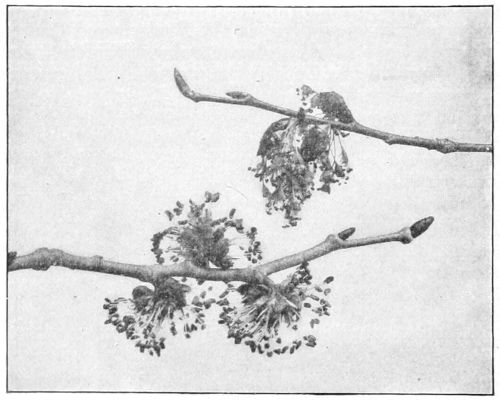
Elm blossoms.
Photo by Ralph Curtis.
The elm roots are water hunters and extend deep into the earth; they will grow towards water, seeming to know the way. The elm heart-wood is reddish, the sap-wood being broad and whitish in color; the wood is very tough because of the interlaced fibers, and therefore very hard to split. It is used for cooperage, wheel hubs, saddlery, and is now used more extensively for furniture; its grain is most ornamental. It is fairly durable as posts, but perhaps the greatest use of all for the tree is for shade. The slippery elm is much like the white elm, except that its inner bark is very mucilaginous, and children love to chew it. The cork elm has a peculiar corky growth on its branches, giving it a very unkempt look. The wahoo, or winged elm, is a small tree, and its twigs are ornamented on each side by a corky layer. The English elm has a solid, round head, very different from that of our graceful species. The elms are long-lived, some living for centuries. The Washington elm in Cambridge, and the William Penn elm in Philadelphia, which now has a monument to mark its place, were famous trees.
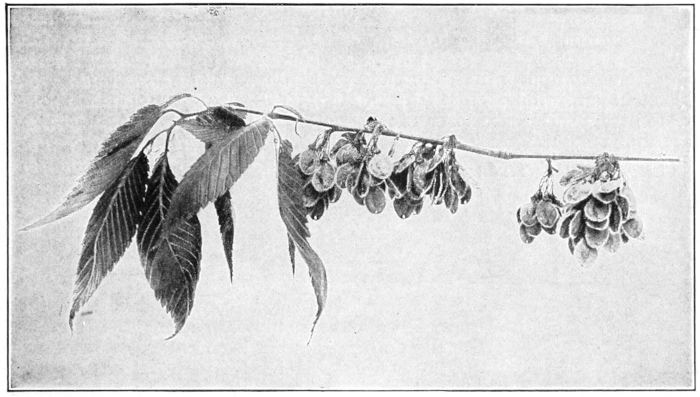
Elm seed.
Photo by Morgan.
03The original lesson and questionsTake these to the subject itself
Questions to explore
Choose what fits this encounter. Some original prompts ask for collecting, handling, or other historical activities; use a safe observation instead. Write or draw only in a paper nature journal.
The Elm
Leading thought—The elm has a peculiarly graceful form, which makes it of value as a shade tree. It grows best in moist locations. Its wood is very tough.
Method—This work should be begun in the fall with the study of the shape of the tree and its foliage. Sketches should be made when the tree is clothed in autumn tints, and later it should be sketched again when its branches are naked. Its blossoms should be studied in March and April and its seeds in May.
Observations—1. Where does the elm grow? Does it thrive where there is little water? What is the usual shape of the elm? How does the trunk divide into branches to make this shape possible? What is the shape of the larger elms? Describe the spray. Describe the elm bark. How can you tell the elm from other trees in winter?
2. Study the elm leaf. What is its form? What kind of edges has it? How large is it? What is the difference in appearance and feeling between the upper and lower sides? Are the leaves rough above whichever way you stroke them? If a leaf is folded lengthwise are the two halves exactly alike? How are the leaves arranged on the twig? What is their color above and below? Describe the leafy growth along the trunk.
3. What is the color of the elm tree in autumn? Make a sketch of the elm tree you are studying.
4. What sort of roots has the elm? Do they grow deep into the earth? What is the character of its wood? Is it easy to split? Why? What are the chief uses of the elm?
5. Do you know what distinguishes the slippery elm, the cork elm, the winged elm, or wahoo, and the English elm from the common American or white elm which you have been studying?
6. Write an essay on two famous American elms.
7. What birds love to build in the elm trees?
Spring Study of the Elm
8. Which appear first, the blossoms or the leaves? Describe the elm blossom. How long before the seeds ripen? How are the seeds attached to the twig? Describe an elm seed. How are the seeds scattered? How are the young leaves folded as they come out of the bud?
Supplementary reading—Trees in Prose and Poetry, pp. 81–92.
Comstock, Handbook of Nature-Study, Lesson CXCI. Read the illustrated original at Project Gutenberg. Public domain in the United States.