
Meet the living subject or observe the natural phenomenon first. Ask a few questions aloud and give students time to discover what observation can answer. Leave the unanswered questions for later research. A sketch or written narration belongs in a paper nature journal.
This historical lesson is reproduced as a source, not as current animal-care, collecting, medical, or experiment advice. Observe wildlife without disturbing it, follow local rules, and check present-day safety guidance before any hands-on work. Never look directly at the Sun.
01How to use this lessonA short field guide for the adult
Let the subject lead.
Read the teacher material in advance if possible. During observation, select only the questions the student can investigate today. Do not answer on the student’s behalf while there is still something to see, hear, compare, or measure safely. Afterward, invite an oral narration or a picture in a paper nature journal. Discuss remaining questions only once observation is complete.
02The teacher’s readingComstock’s original preparatory text
The teacher’s reading
Text from the original handbook. Page markers are omitted; layout is adapted for reading. The source may reflect 1911 knowledge and practices.
This lesson has no separate teacher story. Read Comstock’s introduction and method in the original lesson below before meeting the subject.
03The original lesson and questionsTake these to the subject itself
Questions to explore
Choose what fits this encounter. Some original prompts ask for collecting, handling, or other historical activities; use a safe observation instead. Write or draw only in a paper nature journal.
How to Make Leaf Prints
A very practical help in interesting children in trees, is to encourage them to make portfolios of leaf-prints of all the trees of the region. Although the process is mechanical, yet the fact that every print must be correctly labeled makes for useful knowledge. One of my treasured possessions is such a portfolio made by the lads of St. Andrews School of Richmond, Va., who were guided and inspired in this work by their teacher, Professor W. W. Gillette. The impressions were made in green ink and the results are as beautiful as works of art. Professor Gillette gave me my first lesson in making leaf prints.
Material—1. A smooth slate, or better, a thick plate of glass, about 12 × 15 inches.
2. A tube of printer’s ink, either green or black, and costing 50 cents; one tube contains a sufficient supply of ink for making several hundred prints. Or a small quantity of printer’s ink may be purchased at any printing office.
3. Two six-inch rubber rollers, such as photographers use in mounting prints, which cost 15 cents each. A letter-press may be used instead of one roller.
4. A small bottle of kerosene to dilute the ink, and a bottle of benzine for cleaning the outfit after using, care being taken to store them safe from fire.
5. Sheets of paper 8½ × 11 inches. The paper should be of good quality, with smooth surface in order that it may take and hold a clear outline. The ordinary paper used in printers’ offices for printing newspapers works fairly well. I have used with success the paper from blank notebooks which cost five cents a piece.
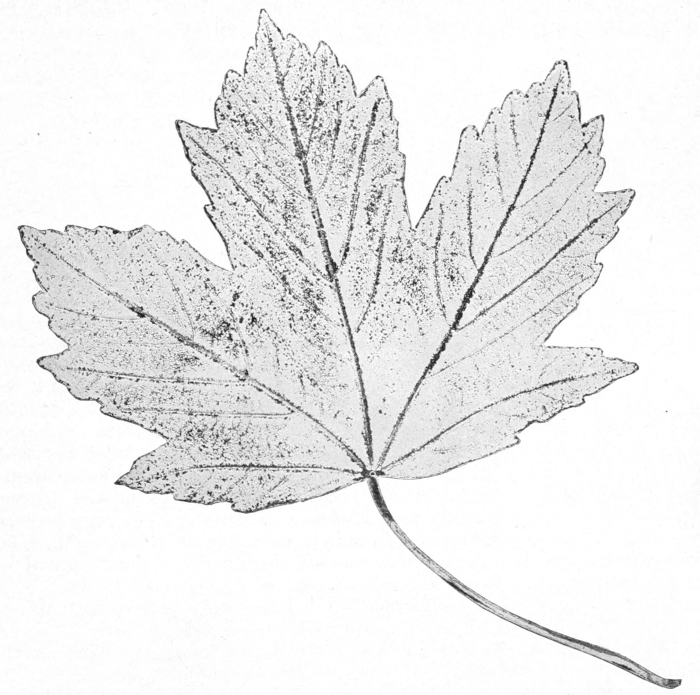
Leaf print of a sycamore maple.
To make a print, place a few drops of ink upon the glass or slate, and spread it about with the roller until there is a thin coat of ink upon the roller and a smooth patch in the center of the glass or slate. It should never be so liquid as to “run,” for then the outlines will be blurred. Ink the leaf by placing it on the inky surface of the glass and passing the inked roller over it once or twice until the veins show that they are smoothly filled. Now place the inked leaf between two sheets of paper and roll once with the clean roller, bearing on with all the strength possible; a second passage of the roller blurs the print. Two prints are made at each rolling, one of the upper, and one of the under side of the leaf. Dry and wrinkled leaves may be made pliant by soaking in water, drying between blotters before they are inked.
Prints may also be made a number at a time by pressing them under weights, being careful to put the sheets of paper with the leaves between the pages of old magazines or folded newspapers, in order that the impression of one set of leaves may not mar the others. If a letter-press is available for this purpose, it does the work quickly and well.
Comstock, Handbook of Nature-Study, Lesson CLXXXIX. Read the illustrated original at Project Gutenberg. Public domain in the United States.