
Meet the living subject or observe the natural phenomenon first. Ask a few questions aloud and give students time to discover what observation can answer. Leave the unanswered questions for later research. A sketch or written narration belongs in a paper nature journal.
This historical lesson is reproduced as a source, not as current animal-care, collecting, medical, or experiment advice. Observe wildlife without disturbing it, follow local rules, and check present-day safety guidance before any hands-on work. Never look directly at the Sun.
01How to use this lessonA short field guide for the adult
Let the subject lead.
Read the teacher material in advance if possible. During observation, select only the questions the student can investigate today. Do not answer on the student’s behalf while there is still something to see, hear, compare, or measure safely. Afterward, invite an oral narration or a picture in a paper nature journal. Discuss remaining questions only once observation is complete.
02The teacher’s readingComstock’s original preparatory text
The teacher’s reading
Text from the original handbook. Page markers are omitted; layout is adapted for reading. The source may reflect 1911 knowledge and practices.
This lesson has no separate teacher story. Read Comstock’s introduction and method in the original lesson below before meeting the subject.
03The original lesson and questionsTake these to the subject itself
Questions to explore
Choose what fits this encounter. Some original prompts ask for collecting, handling, or other historical activities; use a safe observation instead. Write or draw only in a paper nature journal.
The Stinkhorns
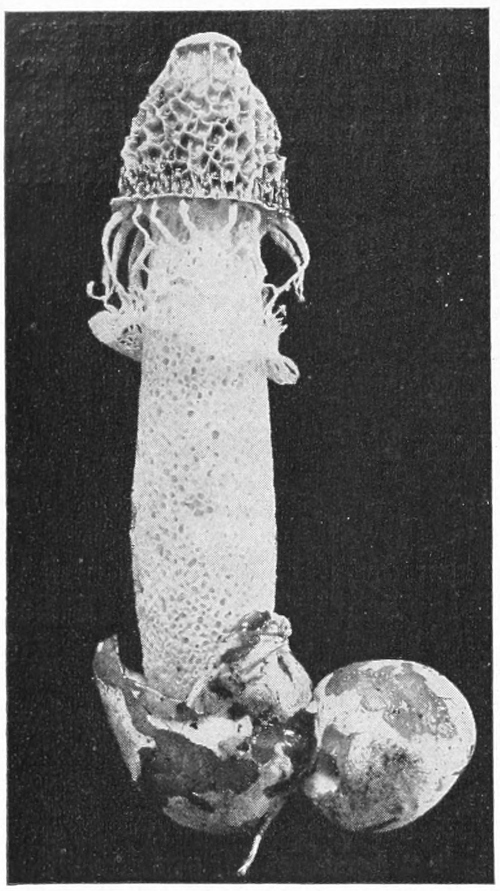
A stinkhorn.
Photo by George F. Atkinson.
To give a nature-study lesson on the stinkhorn is quite out of the question, for the odor of these strange growths is so nauseating that even to come near to one of them in the garden is a disagreeable experience. The reason for mentioning them at all is because of the impression made by them that most mushrooms are ill smelling, which is a slander.
It is a pity that these fungi are so offensive that we do not care to come near enough to them to admire them, for they are most interesting in appearance. The scientific name of our commonest genus when translated means “the net bearers,” and it is a most appropriate name. The stout, white stem is composed of network without and within. The outer covering of the stem seems to tear loose from the lower portion as the stem elongates, and is lifted so that it hangs as a veil around the bottom of the bell-shaped cap, which is always covered with a pitted network. The mycelium, or spawn, of the stinkhorn consists of strands which push their way through the ground or through the decaying vegetable matter on which they feed. On these strands are produced the stinkhorns, which at first look like eggs; but later the top of the egg is broken, and the strange horn-shaped fungus pushes up through it. The spores are borne in the chambers of the cap, and when ripe the substance of these chambers dissolves into a thick liquid in which the spores float. The flies are attracted by the fetid odor and come to feast upon these fungi and to lay their eggs within them, and incidentally they carry the spores away on their brushy feet, and thus help to spread the species.
Comstock, Handbook of Nature-Study, Lesson CLXXXV. Read the illustrated original at Project Gutenberg. Public domain in the United States.