
Meet the living subject or observe the natural phenomenon first. Ask a few questions aloud and give students time to discover what observation can answer. Leave the unanswered questions for later research. A sketch or written narration belongs in a paper nature journal.
This historical lesson is reproduced as a source, not as current animal-care, collecting, medical, or experiment advice. Observe wildlife without disturbing it, follow local rules, and check present-day safety guidance before any hands-on work. Never look directly at the Sun.
01How to use this lessonA short field guide for the adult
Let the subject lead.
Read the teacher material in advance if possible. During observation, select only the questions the student can investigate today. Do not answer on the student’s behalf while there is still something to see, hear, compare, or measure safely. Afterward, invite an oral narration or a picture in a paper nature journal. Discuss remaining questions only once observation is complete.
02The teacher’s readingComstock’s original preparatory text
The teacher’s reading
Text from the original handbook. Page markers are omitted; layout is adapted for reading. The source may reflect 1911 knowledge and practices.
Teacher’s Story
This beautiful garden flower gives a variation in form from other composites when studied according to Lesson CXXXV. This valued garden flower came to us from Europe and it sometimes escapes cultivation and runs wild in a gentle way. We call it bachelor’s button; but in Europe it is called the cornflower, and under this name it found its way into literature. None of the flowers that live in families repays close study better than does the bachelor’s button. The ray-flowers are tubular but they do not have banners. Their tubes flare open like trumpets, and they are indeed color trumpets heralding to the insect world that there is nectar for the probing and pollen for exchange. Looked at from above, the ray-flowers do not seem tubular; from the sides, they show as uneven-mouthed trumpets with lobed edges; but though we search each trumpet to its slender depths we can find no pistils. These ray-flowers have no duty in the way of maturing seeds. In some varieties the ray-flowers are white, and in others they are blue and purple. They vary in number from 7 to 14, or more.
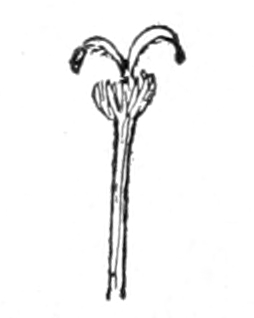
Stigma open and showing pollen-brush below. Enlarged.
The disk-flowers have a long corolla-tube, which is white and delicately lobed and is enlarged toward the upper end to a purple bulb with five, long, slender lobes. The anther-tube is purplish black, and is bent into almost a hook, the tip opening toward the middle of the flower-head. The pollen is glistening white tinged with yellow, and looks very pretty as it bursts out from the dark tubes. The purple stigma first appears with its tips close together, but with a pollen brush just below it; later it opens into a short Y. The buds at the center of the flower are bent hook-shaped over the center of the flower-head. The involucral bracts or “shingles” are very pretty, each one ornamented with a scaly fringe; they form a long, elegantly shaped base to the flower-head. After the flowers have gone and the seeds have ripened, these bracts flare open, making a wide-mouthed urn from which the ripened seeds are shaken by the winds; and after the seeds are gone, the white fuzz of their empty cases remains at the bottom of the urn. The seed is plump and shining, with a short fringe of pappus around the top and a contracted place at one side near the base where it grew fast to the receptacle; for these seeds are not set on end, as are those of the sunflower. The short pappus is hardly sufficient to buoy up the seed, and yet undoubtedly aids it to make a flying jump with the passing breeze.
03The original lesson and questionsTake these to the subject itself
Questions to explore
Choose what fits this encounter. Some original prompts ask for collecting, handling, or other historical activities; use a safe observation instead. Write or draw only in a paper nature journal.
The Bachelor’s
Button
Leading thought—Each bachelor’s button is made up of many little flowers which may be studied by the outline given in Lesson CXXXV.
Comstock, Handbook of Nature-Study, Lesson CLXI. Read the illustrated original at Project Gutenberg. Public domain in the United States.