
Meet the living subject or observe the natural phenomenon first. Ask a few questions aloud and give students time to discover what observation can answer. Leave the unanswered questions for later research. A sketch or written narration belongs in a paper nature journal.
This historical lesson is reproduced as a source, not as current animal-care, collecting, medical, or experiment advice. Observe wildlife without disturbing it, follow local rules, and check present-day safety guidance before any hands-on work. Never look directly at the Sun.
01How to use this lessonA short field guide for the adult
Let the subject lead.
Read the teacher material in advance if possible. During observation, select only the questions the student can investigate today. Do not answer on the student’s behalf while there is still something to see, hear, compare, or measure safely. Afterward, invite an oral narration or a picture in a paper nature journal. Discuss remaining questions only once observation is complete.
02The teacher’s readingComstock’s original preparatory text
The teacher’s reading
Text from the original handbook. Page markers are omitted; layout is adapted for reading. The source may reflect 1911 knowledge and practices.
Teacher’s Story
During April, great patches of blue appear in certain meadows, seeming almost like reflections from the sky; and yet when we look closely at the flowers which give this azure hue to the fields, we find that they are more lavender than blue. The corolla of the bluet is a tube, spreading out into four long, lavender, petal-like lobes; each lobe is paler toward its base and the opening of the tube has a ring of vivid yellow about it, the tube itself being yellow even to its very base, where the four delicate sepals clasp it fast to the ovary until the flower has done its work; and after the corolla has fallen the sepals remain; standing guard over the growing seed.
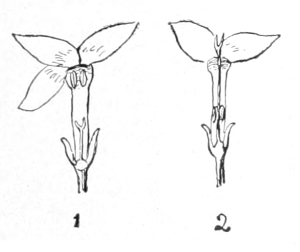
1. Section of a bluet blossom that has the anthers at the throat of the tube and the stigmas below.
2. Section of a bluet with the stigmas protruding and the anthers below.
If we look carefully at the bluets we find two forms of flowers: (a) Those with a two-lobed stigma protruding from the opening of the flower tube. (b) Those where the throat of the tube seems closed by four anthers which join like four fingertips pressed together. In opening the flower, we observe that those which have the stigmas protruding from the tube, have four anthers fastened to the sides of the tube about halfway down; while those that have the four anthers near the opening of the tube, have a pistil with a short style which brings the stigmas about half-way up the tube. Thus an insect visiting flower (a) gets her tongue dusted with pollen from the anthers at the middle of the tube; and this pollen is applied at exactly the right place on her tongue to brush off against the stigmas of a flower of the (b) form. While a bee visiting a bluet of the (b) form receives the pollen at the base of her tongue, where it is conveniently placed to be brushed off by the protruding stigmas of the flowers of the (a) form.
This arrangement in flowers for the reciprocal exchange of pollen characterizes members of the primrose family also; it is certainly a very clever arrangement for securing cross-pollenation.
03The original lesson and questionsTake these to the subject itself
Questions to explore
Choose what fits this encounter. Some original prompts ask for collecting, handling, or other historical activities; use a safe observation instead. Write or draw only in a paper nature journal.
The Bluets
Leading thought—The bluets have two forms of flowers, the anthers and stigmas being placed in different positions in the two, in order to secure cross-pollenation by visiting insects.
Method—Ask the children to bring in several bits of sod covered with bluets. During recess let the pupils, with the aid of a lens if necessary, find the two different forms of flowers. Later, let each see a flower of each form with the tube opened lengthwise.
Observations—1. Where do the bluets grow? Do they grow singly or in masses? On what kind of soil do they grow, in woods or meadows? At what time of year do they bloom?
2. Describe the bluet flower, its color, the shape of its sepals, the form of the corolla, the color of the corolla-tube and lobes.
3. Where is the nectar in the bluet? What color shows where the nectar is to be found?
4. Look directly into the flowers. Do you see any with the stigmas thrust out of the corolla-tube? Is there more than one style? Has it one or two stigmas? Open this flower-tube and describe where the anthers are situated in it. How many anthers are there?
5. Look for a flower where the stigmas do not protrude and the anthers close the throat of the tube. Where are the stigmas in this flower, below or above the anthers? Where are the anthers attached?
6. Work out this problem: How do the insects gathering nectar from one form of the bluets become dusted with pollen in such a way as to leave it upon the stigma of the other form of the bluet flower?
7. How many sepals are there? Do they fall off when the blossom falls?

Showy ladies’ slipper
Photo by Verne Morton.
Comstock, Handbook of Nature-Study, Lesson CXXV. Read the illustrated original at Project Gutenberg. Public domain in the United States.