
Meet the living subject or observe the natural phenomenon first. Ask a few questions aloud and give students time to discover what observation can answer. Leave the unanswered questions for later research. A sketch or written narration belongs in a paper nature journal.
This historical lesson is reproduced as a source, not as current animal-care, collecting, medical, or experiment advice. Observe wildlife without disturbing it, follow local rules, and check present-day safety guidance before any hands-on work. Never look directly at the Sun.
01How to use this lessonA short field guide for the adult
Let the subject lead.
Read the teacher material in advance if possible. During observation, select only the questions the student can investigate today. Do not answer on the student’s behalf while there is still something to see, hear, compare, or measure safely. Afterward, invite an oral narration or a picture in a paper nature journal. Discuss remaining questions only once observation is complete.
02The teacher’s readingComstock’s original preparatory text
The teacher’s reading
Text from the original handbook. Page markers are omitted; layout is adapted for reading. The source may reflect 1911 knowledge and practices.
Teacher’s Story
“The wise men say the hepatica flower has no petals but has pink, white or purple sepals instead: and they say, too, that the three leaflets of the cup which holds the flower are not sepals but are bracts; and they offer as proof the fact that they do not grow close to the blossom, but are placed a little way down the stem. But the hepatica does not care what names the wise men give to the parts of its blossom: it says as plainly as if it could talk: ‘The bees do not care whether they are sepals or petals since they are pretty in color, and show where the pollen is to be found. I will teach the world that bracts are just as good to wrap around flower-buds as are sepals, and that sepals may be just as beautiful as petals. Since my petticoat is pretty enough for a dress why should not I wear it thus?’”—“The Child’s Own Book of Wild Flowers.”
We seek the hepatica in its own haunts, because there is a longing for spring in our hearts that awakens with the first warm sunshine. As we thread our way into sodden woods, avoiding the streams and puddles which are little glacial rivers and lakes, having their sources in the snow-drifts still heaped on the north side of things, we look eagerly for signs of returning life. Our eyes slowly distinguish among the various shades of brown in the floor of the forest, a bit of pale-blue or pink-purple that at first seems like an optical delusion; but as we look again to make sure, Lo! it is the hepatica, lifting its delicate blossoms above its mass of purple-brown leaves. These leaves, moreover, are always beautiful in shape and color and suggest patterns for sculpture like the acanthus, or for rich tapestries like the palm-leaf in the Orient. It warms the heart to see these brave little flowers stand with their faces to the sun and their backs to the snow-drifts, looking out on a gray-brown world, nodding to it and calling it good.
The hepatica is forehanded in several ways. After the leaves have fallen from the trees in the autumn and let in the sunshine, it puts up new leaves which make food that is stored in the crown bud; the little flower buds are then started, and wrapped cozily, are cuddled down at the very center of the plant. These buds, perfected in the autumn, are ready to stretch up and blossom when the first warmth of spring shall reach them. The stems and the bracts of the flower are soft and downy, and are much more furry than those which appear later; while this down is not for the purpose of keeping the plant at a higher temperature, yet it acts as a blanket to prevent too rapid transpiration, which is a cooling process, and thus it does, as a matter of fact, keep the flower warmer. As the stems lift up, the buds are bent, which position protects them from the beating storms. The hepatica flowers are white, pink and lavender. The latter are sometimes called “blue.” The so-called “petals” number from six to twelve; there are usually six. The three outer ones are sepals and are exactly like the three inner ones, the petals, but may be distinguished by their outside position in the half-opened flower. The three green bracts which encase the flower bud, and later remain with the seed, are placed on the stem quite distinctly below the flower. On dark days and during the nights, the young blossoms close; but when they become old and faded, they remain open all the time. Thus, the flowers are closed except when bees are likely to visit them; but after they have shed their pollen, they do not need to remain closed any longer. Not all hepatica blossoms are fragrant; and those that are so, lose their fragrance as their colors begin to fade to white. If a snow-storm comes, the hepatica blossoms close and bow their heads.
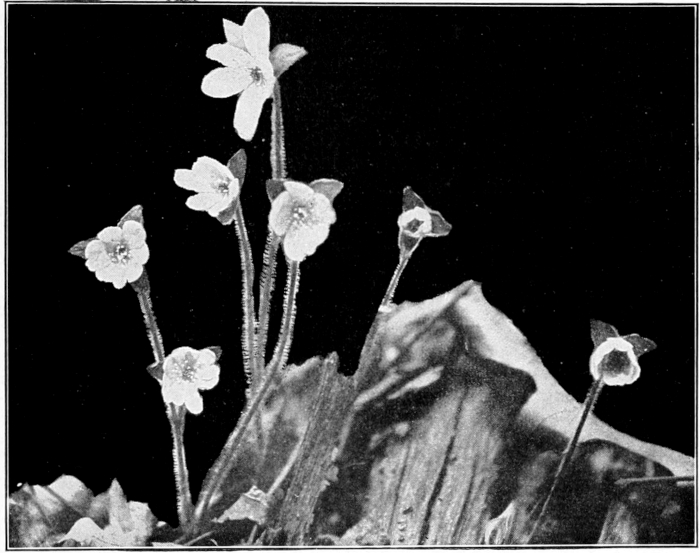
Hepaticas.
There are many stamens with greenish white anthers and pollen. They stand erect around the many pistils at the center of the flower. The number of pistils varies from six to twenty-four. Each pistil holds aloft the little horseshoe-shaped, whitish stigma and, if pollenated, develops into a seed. The hepatica is a perennial and grows only in rich, moist woods. It is so adapted to the shade, that it dies if transplanted to sunny places. The leaves which have passed the winter under the snow are rich purple beneath, and mottled green and purple above, making beautiful objects for water-color drawings. The new leaves are put forth in spring before the leaves of the trees create too much shade. In the fall, after the trees are bare, the leaves again become active. The roots are quite numerous and fine.
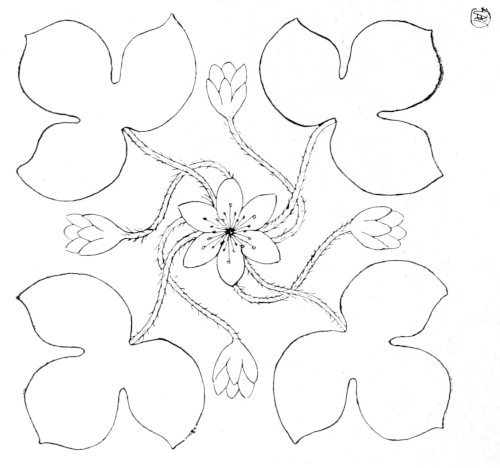
Embroidery design from the hepatica.
The Child’s Own Book of Wild Flowers, drawn by Evelyn Mitchell.
03The original lesson and questionsTake these to the subject itself
Questions to explore
Choose what fits this encounter. Some original prompts ask for collecting, handling, or other historical activities; use a safe observation instead. Write or draw only in a paper nature journal.
The Hepatica
Leading thought—The hepatica flower buds are developed in the fall, so as to be ready to blossom early in the spring. This plant lives only in moist and shady woods.
Method—The pupils should have the questions before they go into the woods to gather spring flowers, and should answer them individually. However, the hepatica plant may be potted early in the spring, and the flowers may be watched during their development, and studied in the schoolroom.
Observations—1. Where do you find the hepaticas? Do you ever find them in the open fields? Do you ever find them in the pine woods?
2. How do the leaves look in early spring? Sketch in color one of these old leaves. How do the young leaves look? Are the leaves that come up late in the spring as fuzzy as those that appear early? What is the difference in texture and color between the leaves that were perfected in the fall and those that appear in the spring?
3. Find a hepatica plant before it begins to blossom. Look, if possible, at its very center. Describe these little flower buds. When were they formed?
4. How does the bud look when it begins to lift up? Describe the stems and the three little blankets that hold the bud. Ask your teacher how these fuzzy blankets keep the bud from being killed by cold.
5. Are the hepaticas in your woods all pink, or blue, or white? Do those which are at first pink or blue fade to white later? Do the blossoms keep open during the night and stormy weather? Why not? Are they all fragrant?
6. How many petals has your hepatica? Can you see that the outer ones are sepals, although they look just like the petals? Peel back the three sepal-like bracts and see that they are not a part of the flower at all but join the stem below the flower.
7. Describe the stamens in the hepatica. How many pistils are there? Does each pistil develop into a seed? How do the three bracts protect the seeds as they ripen?
8. What insects do you find visiting the hepaticas?
9. Describe a hepatica plant in the woods; mark it so that you will know it, and visit it occasionally during the summer and autumn, noting what happens to it.
Comstock, Handbook of Nature-Study, Lesson CXVII. Read the illustrated original at Project Gutenberg. Public domain in the United States.