
Meet the living subject or observe the natural phenomenon first. Ask a few questions aloud and give students time to discover what observation can answer. Leave the unanswered questions for later research. A sketch or written narration belongs in a paper nature journal.
This historical lesson is reproduced as a source, not as current animal-care, collecting, medical, or experiment advice. Observe wildlife without disturbing it, follow local rules, and check present-day safety guidance before any hands-on work. Never look directly at the Sun.
01How to use this lessonA short field guide for the adult
Let the subject lead.
Read the teacher material in advance if possible. During observation, select only the questions the student can investigate today. Do not answer on the student’s behalf while there is still something to see, hear, compare, or measure safely. Afterward, invite an oral narration or a picture in a paper nature journal. Discuss remaining questions only once observation is complete.
02The teacher’s readingComstock’s original preparatory text
The teacher’s reading
Text from the original handbook. Page markers are omitted; layout is adapted for reading. The source may reflect 1911 knowledge and practices.
Teacher’s Story
THERE are certain spiders which are crablike in form, and their legs are so arranged that they can walk more easily sidewise or backward than forward. These spiders spin no webs, but lie in wait for their prey. Many of them live upon plants and fences and, in winter, hide in protected places.
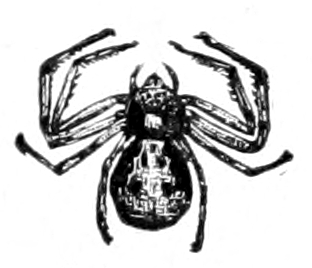
A common crab-spider.
The white crab-spider is a little rascal that has discovered the advantage of protective coloring as a means of hiding itself from the view of its victims, until too late to save themselves; the small assassin always takes on the color of the flower in which it lies concealed. In the white trillium, it is greenish white; while in the golden-rod its decorations are yellow. It waits in the heart of the flower, or in the flower clusters, until the visiting insect alights and seeks to probe for the nectar; it then leaps forward and fastens its fangs into its struggling victim. I have seen a crab-spider in a milkweed attack a bee three times its size. This spider was white with lilac or purple markings. If disturbed, the crab-spider can walk off awkwardly or it may drop by a silken thread. It is especially interesting, since it illustrates another use for protective coloring; and also because this species seems to be able to change its colors to suit its surroundings.
03The original lesson and questionsTake these to the subject itself
Questions to explore
Choose what fits this encounter. Some original prompts ask for collecting, handling, or other historical activities; use a safe observation instead. Write or draw only in a paper nature journal.
The White Crab-spider
Leading thought—1. The white crab spider has markings upon its body of the same color as the flower in which it rests and is thus enabled to hide in ambush out of the sight of its victims—the insects which come to the flower for nectar.
Method—Ask the children to bring one of these spiders to school in the flower in which it was found; note how inconspicuous it is, and arouse an interest in the different colors which these spiders assume in different flowers.
Observations—1. What is the shape of the body of the crab-spider? Which of the legs are the longest? Are these legs directed forward or backward?
2. How is the body marked? What colors do you find upon it? Are the colors the same in the spiders found in the trilliums, as those in other flowers? Why is this? Do you think that the color of the spider keeps it from being seen?
3. Place the white spider which you may find in a trillium in a daffodil, and note if the color changes.
4. Do the crab-spiders make webs? How do they trap their prey?
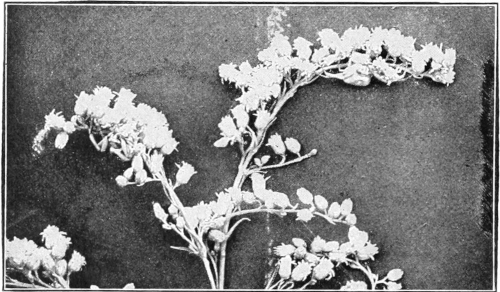
Crab-spiders on golden-rod.
This species is white when lurking in the white trillium and yellow when among flowers of the golden-rod.
Photo by Slingerland.
Comstock, Handbook of Nature-Study, Lesson CXV. Read the illustrated original at Project Gutenberg. Public domain in the United States.