
Meet the living subject or observe the natural phenomenon first. Ask a few questions aloud and give students time to discover what observation can answer. Leave the unanswered questions for later research. A sketch or written narration belongs in a paper nature journal.
This historical lesson is reproduced as a source, not as current animal-care, collecting, medical, or experiment advice. Observe wildlife without disturbing it, follow local rules, and check present-day safety guidance before any hands-on work. Never look directly at the Sun.
01How to use this lessonA short field guide for the adult
Let the subject lead.
Read the teacher material in advance if possible. During observation, select only the questions the student can investigate today. Do not answer on the student’s behalf while there is still something to see, hear, compare, or measure safely. Afterward, invite an oral narration or a picture in a paper nature journal. Discuss remaining questions only once observation is complete.
02The teacher’s readingComstock’s original preparatory text
The teacher’s reading
Text from the original handbook. Page markers are omitted; layout is adapted for reading. The source may reflect 1911 knowledge and practices.
Teacher’s Story
THERE seems to have been an hereditary war between the farm boy and the bumblebee, the hostilities usually initiated by the boy. Like many wars, it is very foolish and wicked, and has resulted in great harm to both parties. Luckily, the boys of to-day are more enlightened; and it is to be hoped that they will learn to endure a bee sting or two for the sake of protecting these diminishing hosts, upon which so many flowers depend for carrying their pollen; for of all the insects of the field, the bumblebees are the best and most needed friends of the flowers.
The bumblebees are not so thrifty and forehanded as are the honeybees, and do not provide enough honey to sustain the whole colony during the winter. Only the mother bees, or queens as they are called, survive the cold season. Just how they do it, we do not know, but probably they are better nourished and therefore have more endurance than the workers. In early May, one of the most delightful of spring visitants is one of these great buzzing queens, flying low over the freshening meadows, trying to find a suitable place for her nest; and the farmer or fruit grower who knows his business, is as anxious as she that she find suitable quarters, knowing well that she and her children will render him most efficient aid in growing his fruit and seed. She finally selects some cosy place, very likely a deserted nest of the field mouse, and there begins to build her home. She toils early and late, gathering pollen and nectar from the blossoms of the orchard and other flowers which she makes into a special kind of bee-bread, by mixing it with nectar. This is packed in an irregular mass and on it she lays a few eggs; each little bee grub, as soon as it hatches, burrows into the bee-bread, making a little cave for itself while satisfying its appetite. After it is fully grown, it spins about itself a cocoon and changes to a pupa, and later emerges a full-fledged worker bumblebee, being scarcely more than half as large as her queen mother. These workers or daughters of the family find full satisfaction in life in attending to the wants of the growing family. They gather more pollen and mix it with honey, making larger masses for the young to burrow in; meanwhile, the queen remains at home and devotes her energies to laying eggs for the enlargement of the colony. The workers not only care for the young, but later they strengthen the silken pupa cradles with wax, and thus make them into cells for storing honey. When we understand that the cells in the bumblebee’s nest are simply made by the young bees burrowing in any direction, we can understand why the bumblebee comb is so disorderly in the arrangement of its cells. Perhaps the boy of the farm would find the rank bumblebee honey less like the ambrosia of the gods, if he knew that it was stored in the deserted cradles and swaddling clothes of the bumblebee grubs.
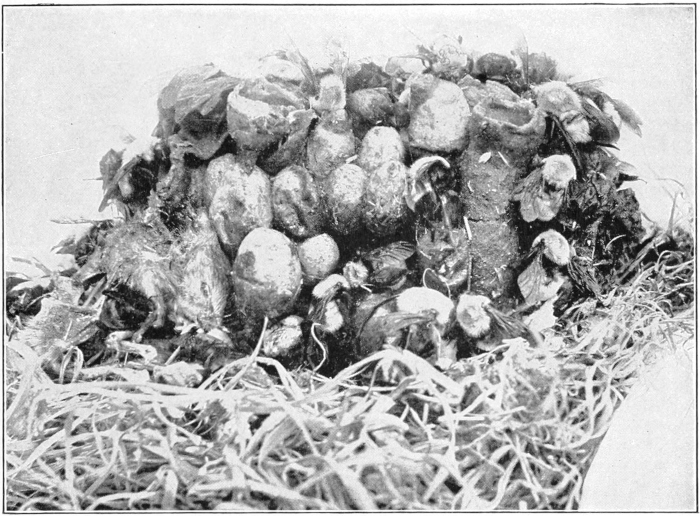
A bumblebee’s nest after a frost. Note the mummy of the first owner of the nest.
Photo by Slingerland.
All of the eggs in the bumblebee nest in the spring and early summer develop into workers which do incidentally the vast labor of carrying pollen for thousands of flowers; to these only is granted the privilege of carrying the pollen for the red clover, since the tongues of the other bees are not sufficiently long to reach the nectar. The red clover does not produce seed in sufficient quantity to be a profitable crop, unless there are bumblebees to pollinate its blossoms. Late in the summer, queens and drones are developed in the bumblebee nest, the drones, as with the honey-bees, being mates for the queens. But of all the numerous population of the bumblebee nest, only the queens survive the rigors of winter, and on them and their success depends the future of the bumblebee species.
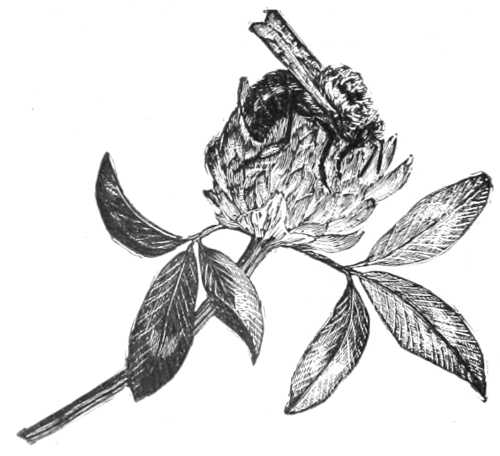
There are many species of bumblebees, some much smaller than others, but they all have the thorax covered with plush above and the abdomen hairy, and their fur is usually marked in various patterns of pale yellow and black. The bumblebee of whatever species, has short but very active antennæ and a mouth fitted for biting as well as for sucking. Between the large compound eyes are three simple eyes. The wings are four in number and strong; the front legs are very short; all the legs have hairs over them and end in a three-jointed foot, tipped by a claw. On the hind leg, the tibia and the first tarsal joint are enlarged, making the pollen baskets on which the pollen is heaped in golden masses. One of the most interesting observations possible to make, is to note how the bumblebee brushes the pollen from her fur and packs it into her pollen baskets.
03The original lesson and questionsTake these to the subject itself
Questions to explore
Choose what fits this encounter. Some original prompts ask for collecting, handling, or other historical activities; use a safe observation instead. Write or draw only in a paper nature journal.
The Bumblebee
Leading thought—The bumblebees are the chief pollen carriers for most of our wild flowers as well as for the clovers and other farm plants. They should, therefore, be kindly treated everywhere; and we should be careful not to hurt the big queen bumblebee which we see often in May.
Method—Ask the questions and encourage the pupils to answer them as they have opportunity to observe the bumblebees working in the flowers. A bumblebee may be imprisoned in a tumbler for a short period for observation, and then allowed to go unharmed. It is not advisable to study the nest, which is not only a dangerous proceeding for the pupil, but it also means the destruction of a colony of these very useful insects. However, if the location of a nest is discovered, it may be dug up and studied after the first heavy frost. Special stress should be laid upon the observations of the actions of the bees when visiting flowers.
Observations—1. In how many flowers do you find the bumblebee? Watch her closely and see how she gets the nectar. Notice how she “bumbles around” in a flower and becomes dusted with pollen. Watch her and note how she gets the pollen off her fur and packs it in her pollen baskets. On which legs are her pollen baskets? How does the pollen look when packed in them? What does she do with pollen and nectar?
2. Catch a bumblebee in a jelly glass and look at her closely. Can you see three little eyes between the big compound eyes? Describe her antennæ. Are they active? How many pairs of wings has she? Do you think they are strong? Which pair of legs is the shortest? How many segments are there in the leg? Do you see the claws on the foot?
3. What is the bumblebee’s covering? What is the color of her plush? Is she furry above and below?
4. Can you see that she can bite as well as suck with her mouth-parts? Will a bumblebee sting a person unless she is first attacked?
5. Have you seen the very large queen bumblebee in the spring, flying near the ground hunting for a place to build a nest? Why must you be very careful not to hurt her? How does she pass the winter? What does she do first, in starting the nest?
6. In how many ways does the bumblebee benefit us?
Comstock, Handbook of Nature-Study, Lesson CII. Read the illustrated original at Project Gutenberg. Public domain in the United States.