
Meet the living subject or observe the natural phenomenon first. Ask a few questions aloud and give students time to discover what observation can answer. Leave the unanswered questions for later research. A sketch or written narration belongs in a paper nature journal.
This historical lesson is reproduced as a source, not as current animal-care, collecting, medical, or experiment advice. Observe wildlife without disturbing it, follow local rules, and check present-day safety guidance before any hands-on work. Never look directly at the Sun.
01How to use this lessonA short field guide for the adult
Let the subject lead.
Read the teacher material in advance if possible. During observation, select only the questions the student can investigate today. Do not answer on the student’s behalf while there is still something to see, hear, compare, or measure safely. Afterward, invite an oral narration or a picture in a paper nature journal. Discuss remaining questions only once observation is complete.
02The teacher’s readingComstock’s original preparatory text
The teacher’s reading
Text from the original handbook. Page markers are omitted; layout is adapted for reading. The source may reflect 1911 knowledge and practices.
This lesson has no separate teacher story. Read Comstock’s introduction and method in the original lesson below before meeting the subject.
03The original lesson and questionsTake these to the subject itself
Questions to explore
Choose what fits this encounter. Some original prompts ask for collecting, handling, or other historical activities; use a safe observation instead. Write or draw only in a paper nature journal.
How to Make the Lubbock Ant-nest
Material—Two pieces of window glass, 10 inches square; a sheet of tin, 11 inches square; a piece of plank, 1¼ inch thick, 20 inches long and at least 16 inches wide; a sheet of tin or a thin, flat board, 10 inches square.
To make the nest—Take the plank and on the upper side, a short distance from the edge, cut a deep furrow. This furrow is to be filled with water, as a moat, to keep the ants imprisoned. It is necessary, therefore, that the plank should have no knot holes, and that it be painted thoroughly to keep it from checking. Take the sheet of tin 11 inches square, and make it into a tray by turning up the edges three-eighths of an inch. Place this tray in the middle of the plank. Place within the tray one pane of glass. Lay around the edges of this glass four strips of wood about half an inch wide and a little thicker than the height of the ants which are to live in the nest. Cover the glass with a thin layer of fine earth. Take the remaining pane of glass and cut a triangular piece off of one corner, then place the pane on top of the other, resting upon the pieces of wood around the sides. The cover of the nest may be a piece of tin, with a handle soldered to the center, or a board with a screw-eye in the center with which to lift it. There should be a piece of blotter or of very thin sponge, introduced into the nest between the two panes of glass, in a position where it may be reached with a pipette, without removing the upper glass, for it must be kept always damp.
To establish a colony in this nest proceed as follows: Take a two-quart glass fruit jar and a garden trowel. Armed with these, visit some pasture or meadow near by, and find under some stone, a small colony of ants which have plenty of eggs and larvæ. Scoop up carefully eggs, ants, dirt and all and place in the jar, being as careful as possible not to injure the specimens. While digging, search carefully for the queen, which is a larger ant and is sometimes thus found. But if you have plenty of eggs, larvæ and pupæ, the ants will become very contented in their new nest while taking care of them. After you have taken all the ants desirable, place the cover on the jar, carry them to the Lubbock nest and carefully empty the contents of the fruit jar on top of the board which covers the nest. Of course the furrow around the plank has been filled with water, so the stragglers cannot escape. The ants will soon find the way into the nest through the cut corner of the upper pane of glass, and will transfer their larvæ to it because it is dark. After they are in the nest, which should be within two or three hours, remove the dirt on the cover, and the nest is ready for observation. But, since light disturbs the little prisoners, the cover should be removed only for short periods.
The Fielde nest is better adapted for a serious study of ants, but it is not so well adapted for the schoolroom as is the Lubbock nest.
Reference—Ants, W. M. Wheeler.
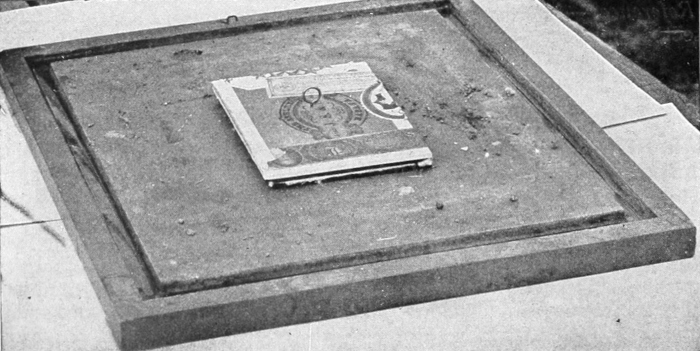
A Lubbock ant-nest.
Comstock, Handbook of Nature-Study, Lesson XCVI. Read the illustrated original at Project Gutenberg. Public domain in the United States.