
Meet the living subject or observe the natural phenomenon first. Ask a few questions aloud and give students time to discover what observation can answer. Leave the unanswered questions for later research. A sketch or written narration belongs in a paper nature journal.
This historical lesson is reproduced as a source, not as current animal-care, collecting, medical, or experiment advice. Observe wildlife without disturbing it, follow local rules, and check present-day safety guidance before any hands-on work. Never look directly at the Sun.
01How to use this lessonA short field guide for the adult
Let the subject lead.
Read the teacher material in advance if possible. During observation, select only the questions the student can investigate today. Do not answer on the student’s behalf while there is still something to see, hear, compare, or measure safely. Afterward, invite an oral narration or a picture in a paper nature journal. Discuss remaining questions only once observation is complete.
02The teacher’s readingComstock’s original preparatory text
The teacher’s reading
Text from the original handbook. Page markers are omitted; layout is adapted for reading. The source may reflect 1911 knowledge and practices.
Teacher’s Story
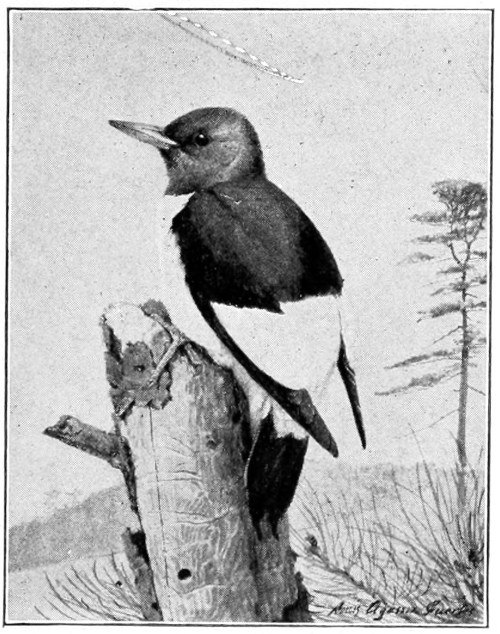
The red-headed woodpecker.
Drawing by L. A. Fuertes.
The red-head is well named, for his helmet and visor show a vivid glowing crimson that stirs the sensibilities of the color lover. It is readily distinguished from the other woodpeckers because its entire head and bib are red. For the rest, it is a beautiful dark metallic blue with the lower back, a band across the wing, and the under parts white; its outer tail feathers are tipped with white. The female is colored like the male, but the young have the head and breast gray, streaked with black and white, and the wings barred with black. It may make its nest by excavating a hole in a tree or a stump or even in a telegraph pole; the eggs are glossy white. This woodpecker is quite different in habits from the hairy and downy, as it likes to flit along from stump to fence-post and catch insects on the wing, like a fly-catcher. The only time that it pecks wood is when it is making a hole for its nest.
As a drummer, the red-head is most adept and his roll is a long one. He is an adaptable fellow, and if there is no resonant dead limb at hand, he has been known to drum on tin roofs and lightning rods; and once we also observed him executing a most brilliant solo on the wire of a barbed fence. He is especially fond of beechnuts and acorns, and being a thrifty fellow as well as musical, in time of plenty he stores up food against time of need. He places his nuts in crevices and forks of the branches or in holes in trees or any other hiding place. He can shell a beechnut quite as cleverly as can the deer mouse; and he is own cousin to the Carpenter Woodpecker of the Pacific Coast, which is also red-headed and which drills holes in the oak trees wherein he drives acorns like pegs for later use.
03The original lesson and questionsTake these to the subject itself
Questions to explore
Choose what fits this encounter. Some original prompts ask for collecting, handling, or other historical activities; use a safe observation instead. Write or draw only in a paper nature journal.
The Red-headed Woodpecker
Leading thought—The red-headed woodpecker has very different habits from the downy and is not so useful to us. It lives upon nuts and fruit and such insects as it can catch upon the wing.
Methods—If there is a red-head in the vicinity of your school the children will be sure to see it. Write the following questions upon the blackboard and offer a prize to the first one who will make a note on where the red-head stores his winter food.
Observations—1. Can you tell the red-head from the other woodpeckers? What colors especially mark his plumage?
2. Where does the red-head nest? Describe eggs and nest?
3. What have you observed the red-head eating? Have you noticed it storing nuts and acorns for the winter? Have you noticed it flying off with cherries or other fruit?
4. What is the note of the red-head? Have you ever seen one drumming? What did he use for a drum? Did he come back often to this place to make his music?
Supplementary reading—“The House That Fell” in Nestlings of Forest and Marsh; Our Birds and their Nestlings, p. 90; Birds, Bees and Sharp Eyes, John Burroughs.
Another trait our woodpeckers have that endears them to me, and that has never been pointedly noticed by our ornithologists, is their habit of drumming in the spring. They are songless birds, and yet all are musicians; they make the dry limbs eloquent of the coming change. Did you think that loud, sonorous hammering which proceeded from the orchard or from the near woods on that still March or April morning was only some bird getting its breakfast? It is downy, but he is not rapping at the door of a grub; he is rapping at the door of spring, and the dry limb thrills beneath the ardor of his blows. Or, later in the season, in the dense forest or by some remote mountain lake, does that measured rhythmic beat that breaks upon the silence, first three strokes following each other rapidly, succeeded by two louder ones with longer intervals between them, and that has an effect upon the alert ear as if the solitude itself had at least found a voice—does that suggest anything less than a deliberate musical performance? In fact, our woodpeckers are just as characteristically drummers as is the ruffed grouse, and they have their particular limbs and stubs to which they resort for that purpose. Their need of expression is apparently just as great as that of the song-birds, and it is not surprising that they should have found out that there is music in a dry, seasoned limb which can be evoked beneath their beaks.
The woodpeckers do not each have a particular dry limb to which they resort at all times to drum, like the one I have described. The woods are full of suitable branches, and they drum more or less here and there as they are in quest of food; yet I am convinced each one has its favorite spot, like the grouse, to which it resorts, especially in the morning. The sugar-maker in the maple woods may notice that this sound proceeds from the same tree or trees about his camp with great regularity. A woodpecker in my vicinity has drummed for two seasons on a telegraph-pole, and he makes the wires and glass insulators ring. Another drums on a thin board on the end of a long grape-arbor, and on still mornings can be heard a long distance.
A friend of mine in a Southern city tells me of a red-headed woodpecker that drums upon a lightning-rod on his neighbor’s house. Nearly every clear, still morning at certain seasons, he says, this musical rapping may be heard. “He alternates his tapping with his stridulous call, and the effect on a cool, autumn-like morning is very pleasing.”—John Burroughs, in Birds, Bees and Sharp Eyes.
Comstock, Handbook of Nature-Study, Lesson XVI. Read the illustrated original at Project Gutenberg. Public domain in the United States.