
Meet the living subject or observe the natural phenomenon first. Ask a few questions aloud and give students time to discover what observation can answer. Leave the unanswered questions for later research. A sketch or written narration belongs in a paper nature journal.
This historical lesson is reproduced as a source, not as current animal-care, collecting, medical, or experiment advice. Observe wildlife without disturbing it, follow local rules, and check present-day safety guidance before any hands-on work. Never look directly at the Sun.
01How to use this lessonA short field guide for the adult
Let the subject lead.
Read the teacher material in advance if possible. During observation, select only the questions the student can investigate today. Do not answer on the student’s behalf while there is still something to see, hear, compare, or measure safely. Afterward, invite an oral narration or a picture in a paper nature journal. Discuss remaining questions only once observation is complete.
02The teacher’s readingComstock’s original preparatory text
The teacher’s reading
Text from the original handbook. Page markers are omitted; layout is adapted for reading. The source may reflect 1911 knowledge and practices.
Teacher’s Story
OBVIOUSLY, the hen is a digger of the soil; her claws are long, strong and slightly hooked, and her feet and legs are covered with horny scales as a protection from injury when used in scratching the hard earth, in order to lay bare the seeds and insects hiding there. The hen is a very good runner indeed. She lifts her wings a little to help, much as an athletic runner uses his arms, and so can cover ground with amazing rapidity, her strong toes giving her a firm foothold. The track she makes is very characteristic; it consists of three toe-marks projecting forward and one backward. A bird’s toes are numbered thus:
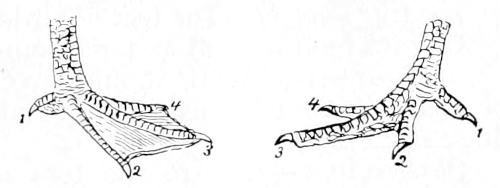
Duck’s foot and hen’s foot with toes numbered.
A duck has the same number of toes as the hen, but there is a membrane, called the web, which joins the second, third and fourth toes, making a fan-shaped foot; the first or the hind toe has a little web of its own. A webbed foot is first of all a paddle for propelling its owner through the water; it is also a very useful foot on the shores of ponds and streams, since its breadth and flatness prevent it from sinking into the soft mud.
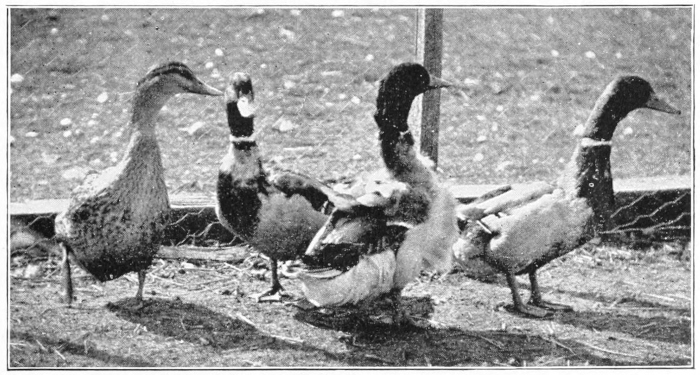
Rouen ducks. The Rouens are colored like the Wild Mallards.
The duck’s legs are shorter than those of the hen and are placed farther back and wider apart. The reason for this is, they are essentially swimming organs and are not fitted for scratching nor for running. They are placed at the sides of the bird’s body so that they may act as paddles, and are farther back so that they may act like the wheel of a propeller in pushing the bird along. We often laugh at a duck on land, since its short legs are so far apart and so far back that its walk is necessarily an awkward waddle; but we must always remember that the duck is naturally a water bird, and on the water its movements are graceful. Think once, how a hen would appear if she attempted to swim! The duck’s body is so illy balanced on its short legs that it cannot run rapidly; and if chased even a short distance, will fall dead from the effort, as many a country child has discovered to his sorrow when he tried to drive the ducks home from the creek or pond to coop. The long, hind claw of the hen enables her to clasp a roost firmly during the night; a duck’s foot could not do this and the duck sleeps squatting on the ground. However, the Muscovy ducks, which are not good swimmers, have been known to perch.
03The original lesson and questionsTake these to the subject itself
Questions to explore
Choose what fits this encounter. Some original prompts ask for collecting, handling, or other historical activities; use a safe observation instead. Write or draw only in a paper nature journal.
The Feet of Birds
Leading thought—The feet of birds are shaped so as to assist the bird in getting its food as well as for locomotion.
Methods—The pupils should have opportunity to observe the chicken or hen and a duck as they move about; they should also observe the duck swimming.
Observations—1. Are the toes of the hen long and strong? Have they long, sharp claws at their tips?
2. How are the legs and feet of the hen covered and protected?
3. How are the hen’s feet and legs fitted for scratching the earth, and why does she wish to scratch the earth?
4. Can a hen run rapidly? What sort of a track does she make?
5. You number your fingers with the thumb as number one and the little finger as five. How do you think the hen’s toes are numbered?
6. Has the duck as many toes as the hen? What is the chief difference between the feet of the duck and the hen?
7. Which of the duck’s toes are connected by a web? Does the web extend to the tips of the toes? What is the web for and how does it help the duck?
8. Are the duck’s legs as long as the hen’s? Are they placed farther forward or farther back than those of the hen? Are they farther apart?
9. Can a duck run as well as a hen? Can the hen swim at all?
10. Where does the hen sleep and how does she hold on to her perch? Could the duck hold on to a perch? Does the duck need to perch while sleeping?
Comstock, Handbook of Nature-Study, Lesson VI. Read the illustrated original at Project Gutenberg. Public domain in the United States.