
Meet the living subject or observe the natural phenomenon first. Ask a few questions aloud and give students time to discover what observation can answer. Leave the unanswered questions for later research. A sketch or written narration belongs in a paper nature journal.
This historical lesson is reproduced as a source, not as current animal-care, collecting, medical, or experiment advice. Observe wildlife without disturbing it, follow local rules, and check present-day safety guidance before any hands-on work. Never look directly at the Sun.
01How to use this lessonA short field guide for the adult
Let the subject lead.
Read the teacher material in advance if possible. During observation, select only the questions the student can investigate today. Do not answer on the student’s behalf while there is still something to see, hear, compare, or measure safely. Afterward, invite an oral narration or a picture in a paper nature journal. Discuss remaining questions only once observation is complete.
02The teacher’s readingComstock’s original preparatory text
The teacher’s reading
Text from the original handbook. Page markers are omitted; layout is adapted for reading. The source may reflect 1911 knowledge and practices.
Teacher’s Story
THE bird’s clothing affords a natural beginning for bird study because the wearing of feathers is a most striking character distinguishing birds from other creatures; also, feathers and flying are the first things the young child notices about birds.
The purpose of all of these lessons on the hen are: (a) To induce the child to make continued and sympathetic observations on the habits of the domestic birds, (b) To cause him involuntarily to compare the domestic with the wild birds, (c) To induce him to think for himself why the shape of the body, wings, head, beak, feet, legs and feathers are adapted in each species to protect the bird and assist it in getting its living.
The overlapping of the feathers on a hen’s back and breast is a pretty illustration of nature’s method of shingling, so that the rain, finding no place to enter, drips off, leaving the bird’s underclothing quite dry. It is interesting to note how a hen behaves in the rain; she droops her tail and holds herself so that the water finds upon her no resting place, but simply a steep surface down which to flow to the ground.
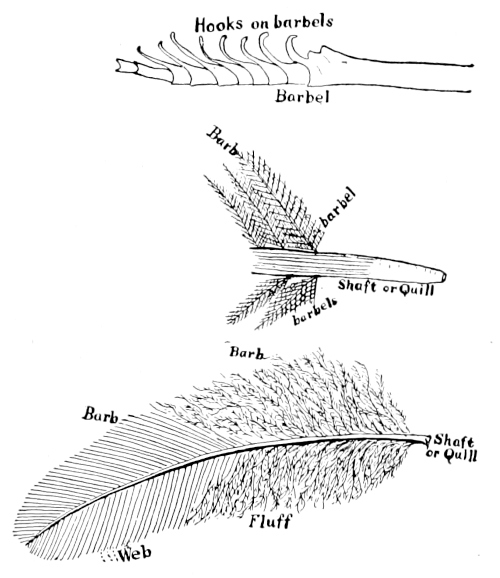
A feather
Each feather consists of three parts, the shaft or quill, which is the central stiff stem of the feather, giving it strength. From this quill come off the barbs which, toward the outer end, join together in a smooth web, making the thin, fan-like portion of the feather; at the base is the fluff, which is soft and downy and near to the body of the fowl. The teacher should put on the blackboard this figure so that incidentally the pupils may learn the parts of a feather and their structure. If a microscope is available, show both the web and the fluff of a feather under a three-fourths objective.
The feathers on the back of a hen are longer and narrower in proportion than those on the breast and are especially fitted to protect the back from rain; the breast feathers are shorter and have more of the fluff, thus protecting the breast from the cold as well as the rain. It is plain to any child that the soft fluff is comparable to our woolen underclothing while the smooth, overlapping web forms a rain and wind-proof outer coat. Down is a feather with no quill; young chicks are covered with down. A pin-feather is simply a young feather rolled up in a sheath, which bursts later and is shed, leaving the feather free to assume its form. Take a large pin-feather and cut the sheath open and show the pupils the young feather lying within.
When a hen oils her feathers it is a process well worth observing. The oil gland is on her back just at the base of the tail feathers; she squeezes the gland with her beak to get the oil and then rubs the beak over the surface of her feathers and passes them through it; she spends more time oiling the feathers on her back and breast than those on the other parts, so that they will surely shed water. Country people say when the hen oils her feathers, it is a sure sign of rain. The hen sheds her feathers once a year and is a most untidy looking bird meanwhile, a fact that she seems to realize, and is as shy and cross as a young lady caught in company in curl papers; but she seems very pleased with herself when she finally gains her new feathers.
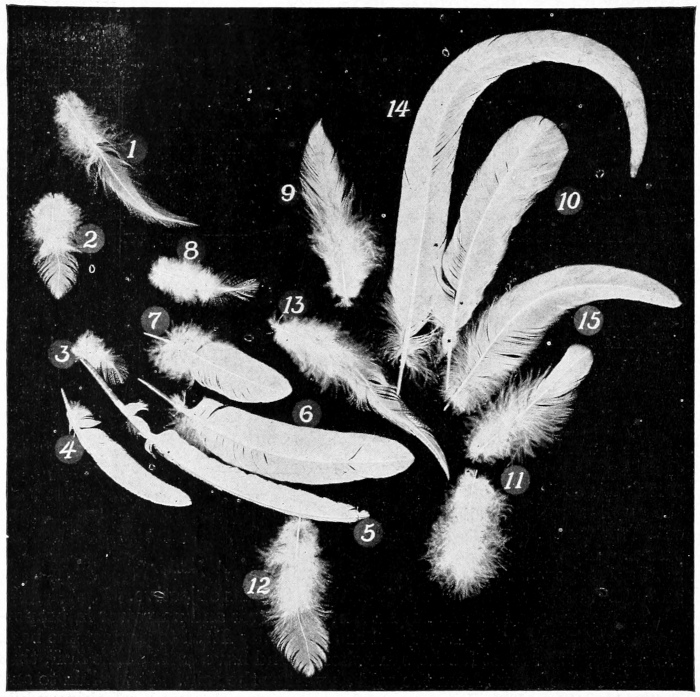
Feathers of a rooster, showing their relative size, shape and position
1, neck hackle; 2, breast; 3, wing shoulder covert; 4, wing flight covert; 5, wing primary; 6, wing secondary; 7, wing covert; 8, back; 9, tail covert; 10, main tail; 11, fluff; 12, thigh; 13, saddle hackle; 14, the sickle or feather of beauty; 15, lesser sickle. Prof. J. E. Rice in Rural School Leaflet.
03The original lesson and questionsTake these to the subject itself
Questions to explore
Choose what fits this encounter. Some original prompts ask for collecting, handling, or other historical activities; use a safe observation instead. Write or draw only in a paper nature journal.
Feathers as Clothing
Leading thought—Feathers grow from the skin of a bird and protect the bird from rain, snow, wind and cold. Some of the feathers act as cloaks or mackintoshes and others as underclothing.
Method—The hen should be at close range for this lesson where the children may observe how and where the different kinds of feathers grow. The pupils should also study separately the form of a feather from the back, from the breast, from the under side of the body, and a pin-feather.
Observations for pupils—1. How are the feathers arranged on the back of the hen? Are they like shingles on the roof? If so, what for?
2. How does a hen look when standing in the rain?
3. How are the feathers arranged on the breast?
4. Compare a feather from the back and one from the breast and note the difference.
5. Are both ends of these feathers alike? If not, what is the difference?
6. Is the fluffy part of the feather on the outside or next to the bird’s skin? What is its use?
7. Why is the smooth part of the feather (the web) on the outside?
8. Some feathers are all fluff and are called “down.” At what age was the fowl all covered with down?
9. What is a pin-feather? What makes you think so?
10. How do hens keep their feathers oily and glossy so they will shed water?
11. Where does the hen get the oil? Describe how she oils her feathers and which ones does she oil most? Does she oil her feathers before a rain?
Comstock, Handbook of Nature-Study, Lesson I. Read the illustrated original at Project Gutenberg. Public domain in the United States.